
While EPD requirements are still being specified, customers already demand precise environmental data – this is how VILPE is acting proactively

Environmental requirements in the construction industry are tightening due to both national and EU-level regulation, but the exact scope and content of EPD obligations are still being clarified. Customers, however, already expect precise, transparent and machine-readable environmental data on products. VILPE has decided to act proactively in relation to the requirements and has responded early by producing EPD-level data, strengthening internal expertise, and using calculation results to support product development.
At the turn of 2026, a significant change will take place in European construction: reporting of a building’s carbon footprint and carbon handprint will become mandatory by law for certain building types, such as terraced houses, apartment buildings, offices, commercial premises, and large warehouse, sports and service buildings. This means that, for a building permit, a calculation of emissions over the entire life cycle of the building must be prepared, and this calculation requires product-specific environmental data either from the national emissions database or from the products’ own EPD declarations.
According to VILPE’s project engineer and EPD expert Milja Sarapää, the content of the obligation is not as straightforward as one might assume.
“Detailed authority guidelines are still being specified in the beginning of 2026 regarding the content and scope of the construction product list. However, it is clear that data on building services products and products integrated into structures will be part of carbon footprint calculations,” Sarapää says.
Although EPDs are currently the most established way of producing comparable environmental data, the new construction act does not directly obligate manufacturers to prepare EPDs. It is still open to what extent product-specific EPD declarations will be required in the future instead of generic data. The obligations will be specified gradually, but it is already evident that competitive tenders and procurement processes increasingly request more detailed environmental information.
At the moment, in Finland and Sweden, the law requires the calculation of a building’s carbon footprint, and if product-specific data is not available, generic values may be used in the calculation. Generic data is based on regional average results that have been increased with a safety factor.
“Generic data is not as representative as product- or product-group-specific data, and due to the safety factor, its emission values are usually higher,” Sarapää explains.
According to Sarapää, the higher emission values of generic data will likely steer the market in practice toward increasing use of product-specific and verified environmental data, even if it is not yet explicitly required for every product. This development is also reinforced by EU-level regulation. The revised Construction Products Regulation (CPR 2024/3110) and the Ecodesign for Sustainable Products Regulation (ESPR 2024/1781) create a framework in which the environmental characteristics, technical performance and traceability of construction products will in the future become part of a Digital Product Passport (DPP).
The introduction of the DPP for construction products will take place in phases, and the timetable depends on when the EU publishes product-group-specific delegated acts. The first product groups may fall under the digital product passport already toward the end of this decade, but the exact schedule varies by product type. Although the details will be clarified later, the direction of development is clear, according to Sarapää: in the future, construction products will be required to provide increasingly precise, transparent and machine-readable environmental data.
Customer requirements are overtaking regulation – the need for precise environmental data is growing
Even though regulation on product-specific environmental data is still partly open, VILPE has noticed that customer requirements are advancing faster than regulation. Many customers need EPD-level and product-specific data regardless of what the law currently requires.
“Customers are already asking for precise figures. They particularly want data based on emissions calculations, and this is clearly visible on the wholesale business. For example, larger customers want machine-readable data that can be fed directly into their systems,” Sarapää says.
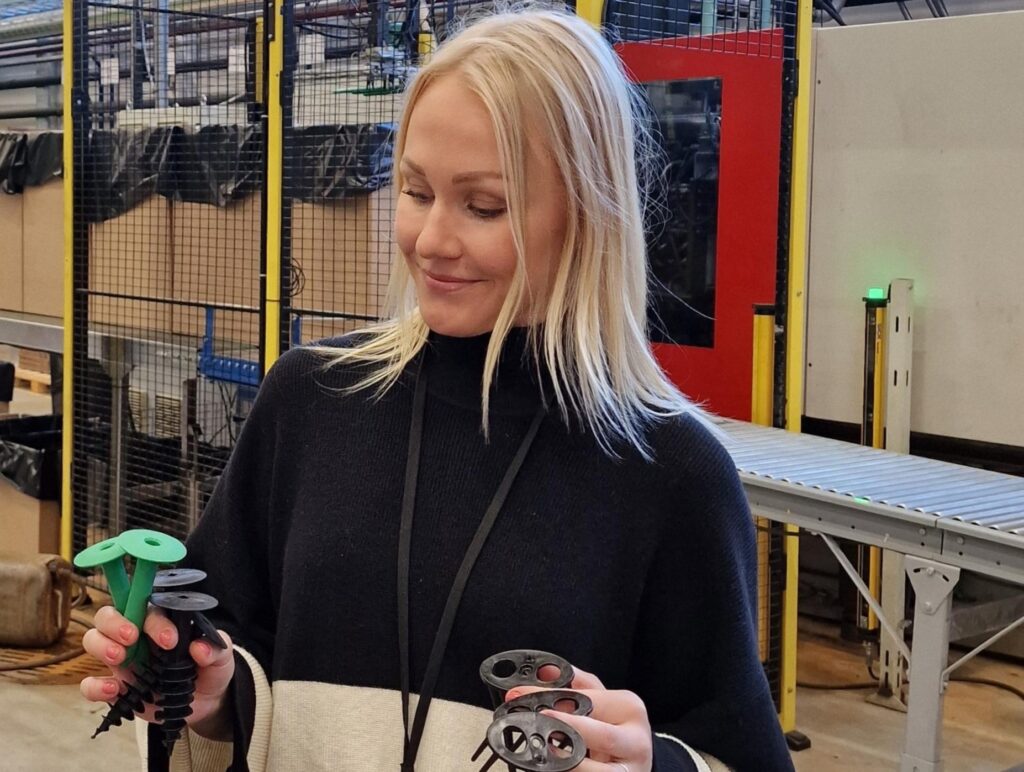
The need for information extends beyond climate impacts. Customers are increasingly asking about packaging materials, recycling rates, the origin of raw materials and the environmental impacts of transport. This requires manufacturers to collect increasingly extensive and detailed product-specific data. In addition to EPD calculations, VILPE also calculates organization-level emissions so that overall impacts can be monitored systematically.
EPD calculation has become a permanent part of VILPE’s operations
Customer information needs have guided VILPE to make a strategic decision to produce EPD-level environmental data more broadly and systematically than current obligations require. VILPE already has 20 EPD declarations published in EPD Hub, with four more in progress, which is a relatively large number considering the size of the company.
“We wanted to make sure that we can answer customers’ questions now, not only once the requirements are eventually specified. That’s why we decided to do EPD work proactively and on a broad scale,” Sarapää explains.
VILPE carries out EPD calculations entirely in-house. According to Sarapää, the calculations are based on life cycle assessment (LCA), and producing them has required thorough familiarization with standards, calculation principles and required documentation. The calculations also take into account whether environmental impacts are reported per kilogram or per product unit, so that results are comparable. An EPD is updated whenever product data changes by more than ±10 percent, and it is valid for five years at a time. At the same time, data collection has been made part of daily operations: material flows in production, supply chain data and packaging material quantities are recorded systematically. The data is currently being prepared for transfer to the ERP system, so that maintenance can be automated in the future.
Calculations lead to concrete changes
The calculations make visible where a product’s emissions originate. According to Sarapää, as much as 70–80 percent of a product’s life-cycle environmental impacts are determined by decisions made already during the design and product development phase. For this reason, VILPE’s product development team is being trained to understand and utilize EPD data as part of decision-making.
EPD work has also led to concrete changes. One significant finding was related to packaging, as packaging density had a clear impact on transport emissions. As a result, the packaging of pass-throughs has been changed from cardboard boxes to plastic bags.
Another major development area was related to raw materials.
“When we examined life-cycle emissions, we identified raw materials as one of the key areas for improvement. In our case, for example, there were large differences between polyamide and polypropylene, which has prompted us to initiate studies on alternative raw materials. Our aim is also to increase the share of recycled raw materials in production,” Sarapää says.
The need for environmental data will increase in the future
According to Sarapää, both the volume of environmental data and the requirements for its accuracy will increase at EU level and in national regulation, and this development is expected to continue far into the future. This requires companies to remain constantly alert so that requirements can be met in a timely manner and with sufficient precision. However, calculation and documentation are not quick tasks.
“LCA calculation and the production of EPD documents are highly standardized, which is desirable for both the final result and the customer. However, it is also labor-intensive in terms of data collection, calculation and reporting. The first round is therefore the most demanding, but also the most educational,” Sarapää concludes.