
How roof leaks disrupt cash flow in shopping centers — and how to prevent it

Summary
Roof leaks are not just maintenance issues: they are direct threats to cash flow in retail and shopping centers. Even minor humidity problems can force store closures, damage inventory, and interrupt peak-season sales: unless they are detected early through real-time roof monitoring such as VILPE Sense.
It’s the busiest hour on Saturday, and the shopping center is full of customers. Suddenly, water begins to drip above the clothing racks. Within minutes, the store is evacuated. The leak may have been developing unnoticed for months, but now the shop must close in the middle of peak shopping season—cutting off sales and putting immediate pressure on cash flow.
A roof leak in a retail or shopping center, or in a department store, is not just a technical issue: it causes reputational damage and can lead to financial downtime. The longer the problem persists, the more the business suffers. Smart IoT-based roof monitoring, such as VILPE Sense, addresses this risk by detecting problems before they disrupt operations.
Challenge: Why Roof Leaks Can Stop Cash Flow in Shopping Centers, Stores and Commercial Spaces
A roof leak or structural humidity problem can instantly affect store operations. Even partial closures lead to lost sales, stalled cash flow, and frustrated tenants—while competitors benefit from uninterrupted operations. Leakage also threatens stockrooms. If water reaches stored products, the damage creates unnecessary waste and forces staff to spend valuable hours reviewing and cleaning inventory.
Identifying the source of a leak is often a challenge. Roof damage may be tiny and nearly impossible to spot on large surfaces, and water can travel long distances before appearing inside the building. As a result, the visible leak may be far from the actual source, delaying repairs.
In a shopping center, even a small-seeming leak can shut down several stores. This reduces turnover. The average cost of downtime is €4,800 per minute (€288,000 per hour) // USD 5,600 per minute (USD 336,000 per hour). Source: FusionConnect, 2024.
Solution: Real-time Roof Monitoring Protects Cash Flow
A structurally healthy roof keeps tenants operating and revenue flowing. It helps prevent loss of turnover and mitigate cash flow risk. To achieve this, shopping centers need visibility into what is happening inside the roof structure. Real-time monitoring of the roof structure can be implemented with VILPE Sense Leak Detectors, Humidity Control, or a combination of both.
VILPE Sense Leak Detectors
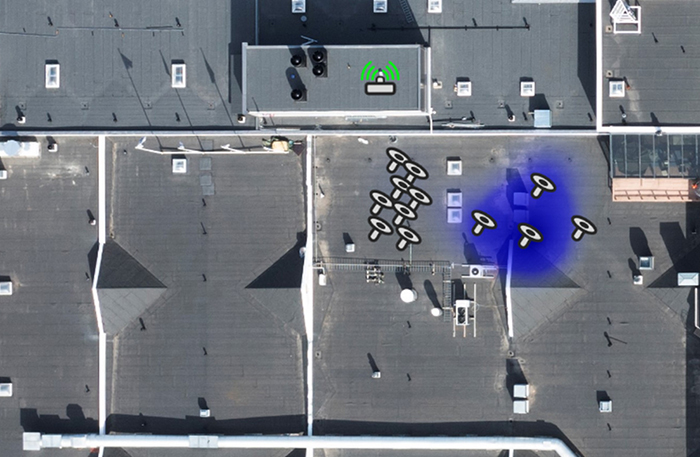
VILPE Sense Leak Detectors are installed directly into the roof’s insulation layer at intervals of approximately 4–5 meters (around 10 sensors per 200 m²). A mobile base station receives the data collected by the VILPE Sense leak detection sensors. It uploads and stores this data directly to VILPE’s cloud service for further analysis.
Through the cloud service, shopping center property managers or maintenance companies can view a real-time humidity map that pinpoints potential leak locations. The owner can set alarm thresholds, which makes busy daily operations easier, as they receive an email alert if humidity levels rise. This enables fast action. Early detection prevents water from reaching interior spaces and allows repairs to be targeted accurately and efficiently.
VILPE Sense Humidity Control
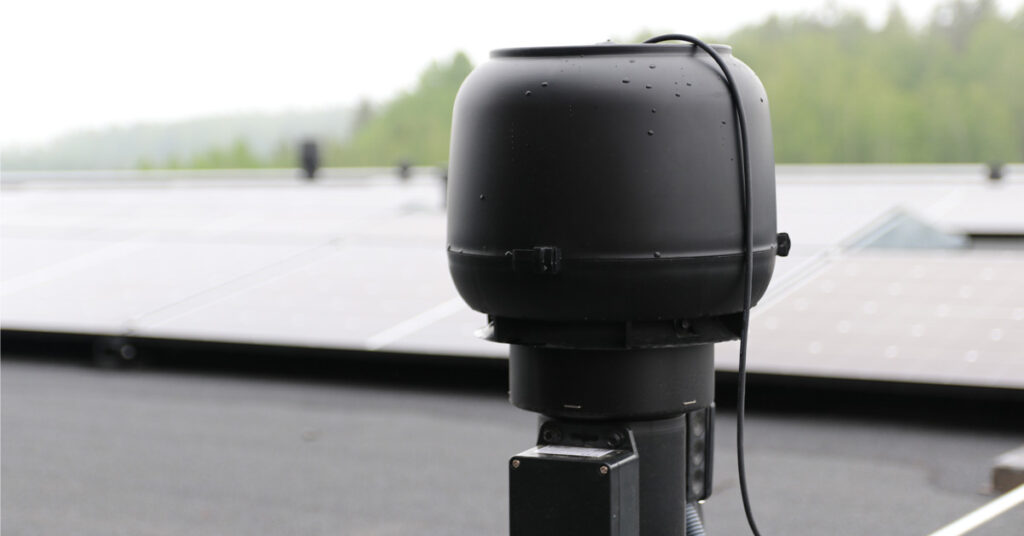
Humidity problems don’t always result from leaks: sometimes structures simply do not ventilate properly. Insufficient ventilation prevents structures from drying, and excess humidity promotes mold growth. VILPE Sense Humidity Control ensures optimal structural ventilation and keeps the insulation layer dry.
The system measures temperature and relative humidity outdoors and in structures. Using these measurements, the algorithm calculates, among other things, the corresponding absolute humidity values, which control the roof fan speed based on demand. The algorithm uses absolute humidity values because warm air can hold much more water than the same volume of cold air, and relative humidity alone does not indicate the amount of humidity in the structure or air.
The roof fan has certain limits that it cannot exceed or fall below. For example, during rain, the outdoor humidity level is high, and the roof fan runs at a minimum speed. When the rain stops and the air becomes drier, the roof fan speed increases. In this way, VILPE Sense humidity control keeps the roof structure’s ventilation at an optimal level at all times.
The system data is available in the VILPE Sense cloud service, where users can examine the data in more detail if needed or set alert thresholds. This saves valuable working time, as the user does not need to constantly monitor the data but can check it whenever necessary.
Concrete Business Benefits: How Roof Monitoring Protects Store Cash Flow
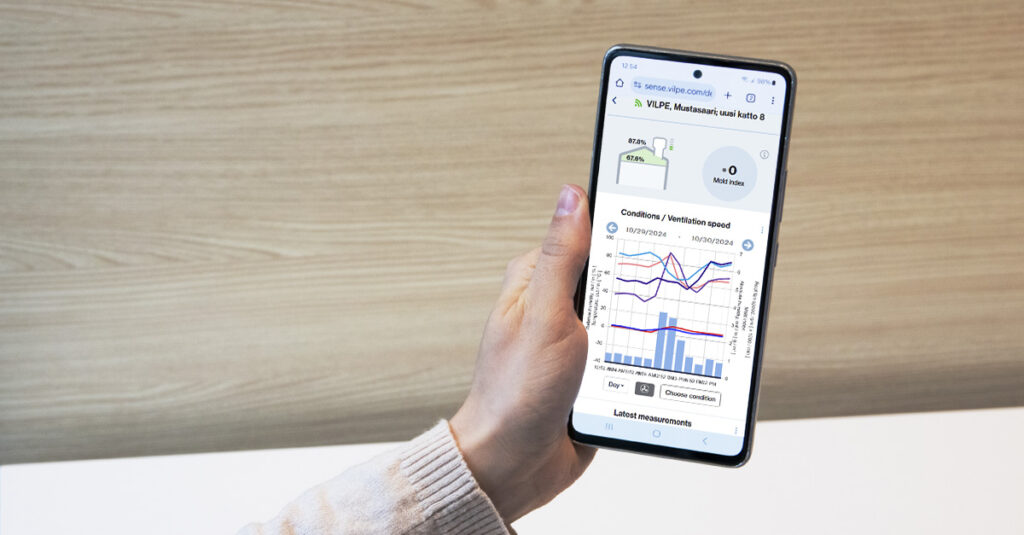
VILPE Sense helps shopping centers safeguard business continuity by preventing humidity problems before they affect tenants. Key benefits include:
- Cash flow protection. Prevents small leaks from escalating into store closures and lost revenue.
- Operational reliability. Stores stay open, and maintenance teams can anticipate upcoming renovations
- Predictable maintenance. Enables planned repairs instead of emergency shutdowns
- Inventory protection. Prevents humidity damage to stock and storage areas.
- Cost savings. The shopping center can react to problems early, keeping repair and maintenance costs lower.
- Documentation. The VILPE Sense data reveals when and where issues began, supporting warranty and liability discussions.
- Transparency. Property owners and maintenance teams can share real-time data with tenants to increase transparency and trust.
The Role of Cash Flow in Modern Retail Risk Management

In retail, every day’s sales matter. Especially for smaller businesses, even a single day’s loss of cash flow is a significant financial setback. An intact, well-monitored roof is a critical component of protecting business operations.
Shopping centers should consider warranty issues related to roof repairs and maintenance. Often, the warranty only covers unexpected damage, such as a tree falling onto the roof. In contrast, long-developing humidity damage inside structures is more difficult to claim. The shopping center owner should understand what the warranty includes: if roof humidity damage harms storage products or if retail spaces must be closed for repairs, does the insurance cover loss of revenue?
The roofing material manufacturer and installer likely also provide a warranty for their product and work. However, the warranty period is limited. In addition, liability issues can cause problems. Even if the roofing material has been manufactured and installed correctly, it may still be damaged during later installations or maintenance visits. In such cases, the property owner may find it difficult to determine what caused the damage and who is liable. The roof warranties may also expire if additional installations, such as solar panel installations, are carried out on the roof.
In modern retail risk management, preventing revenue loss requires more than reactive maintenance. Data-driven monitoring enables shopping center owners to detect risks early, make informed decisions, and prevent avoidable business interruptions. By providing continuous insight into roof conditions, VILPE Sense helps shopping centers reduce uncertainty, extend roof lifespan, and protect the financial performance of their tenants.
Protect your shopping center’s cash flow before problems become visible.
Learn how VILPE Sense enables real-time roof monitoring for retail and commercial properties.
See how other buildings benefit from VILPE Sense
FAQ: Frequently Asked Questions
How does roof monitoring help prevent cash flow losses in retail and storage spaces?
Roof monitoring with VILPE Sense detects humidity and leak risks at an early stage before they cause visible damage or operational interruptions. When the property owner or maintenance company detects potential problems early, store closures, inventory loss and costly repairs—which would weaken cash flow—can be avoided. VILPE Sense also helps prioritize maintenance actions, reducing unexpected costs and keeping spaces operational.
Can the system be installed in large shopping centers? Are there limitations?
Yes, VILPE Sense is suitable for installation in large roof areas, and there are no size limitations. VILPE Sense leak detectors can be installed on the roof in any quantity needed. The recommendation is approximately 10 sensors per 200 square meters. As the building size increases, it requires more sensors.
How does the system perform if the roof has many pass-throughs and technical installations?
VILPE Sense works effectively even in roof structures with numerous pass-throughs or building technology installations, such as solar panels. VILPE Sense is also suitable for green roofs.
What if the leak is caused by a third-party installation—does it still get documented?
Yes. VILPE Sense records temperature and humidity values inside the structure. Humidity control measures it every two hours and leak detectors every 12 hours. The data is stored regardless of who performed the installation. VILPE Sense provides an objective data source that helps determine where the issue is and when it began.
Can Sense be integrated into the shopping center’s own systems?
Yes, integration is possible. VILPE Sense can be connected to building automation systems, allowing the property owner or maintenance company to view the data and combine it with other building technology information.