
Publication in IIBEC Interface
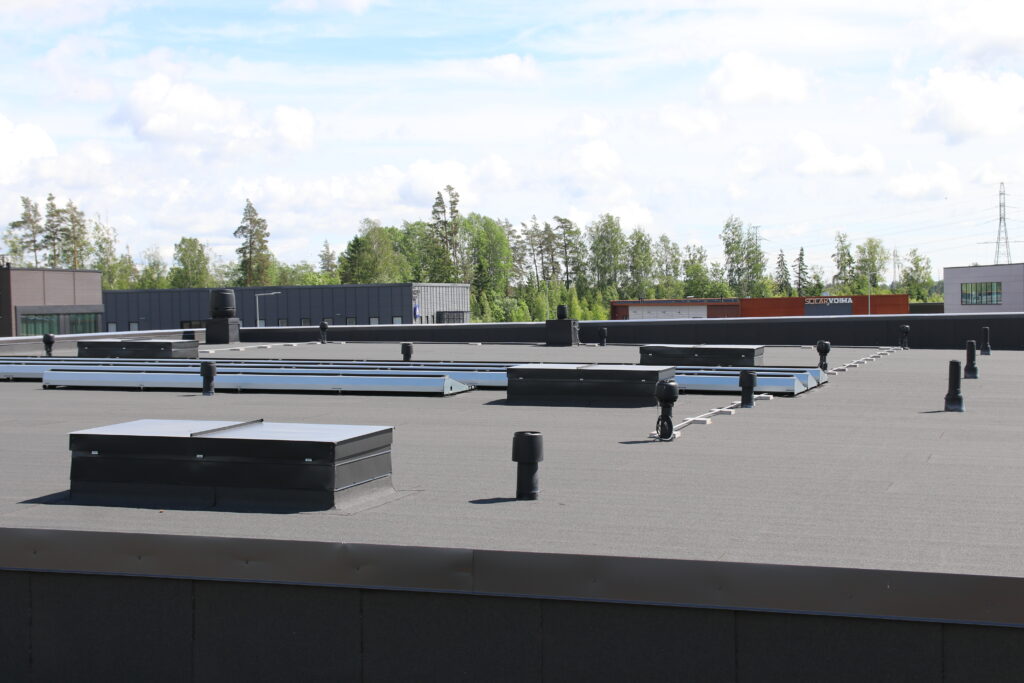
A new peer-reviewed article by VILPE researcher Katarina Hellén has been published in IIBEC Interface, the technical journal of the International Institute of Building Enclosure Consultants (IIBEC).
A simulation study conducted by Ramboll Finland shows that ventilation can support the drying of moisture in low-slope roof structures. However, demand-controlled mechanical ventilation provided significantly faster drying and a lower risk of mold growth than passive underpressure ventilation.
Key findings:
- Mechanical ventilation brought the mineral wool insulation to equilibrium moisture levels in less than 1.5 years.
- Passive underpressure ventilation required nearly three years to achieve similar conditions.
- Underpressure ventilation did not keep moisture levels low enough to prevent mold risk in all parts of the roof structure.
- The mechanical system kept the mold index well below the critical threshold.
- Demand-based control adjusted airflow according to temperature and humidity, reducing or stopping ventilation when outdoor conditions were unfavorable.
- The results suggest that ventilation performance should be assessed based on drying time—not simply whether air is moving through the structure.
The study was based on hygrothermal simulations of a low-slope roof structure with mineral wool insulation following a simulated roof leak. The findings apply to the modeled roof assembly and climate conditions. Field measurements are needed to confirm performance under varying real-world conditions. The study was commissioned by VILPE Oy and conducted by Ramboll Finland Oy.